Create Reports for Recipe & Batch Management
The Report Studio is still under development and has not officially been released. Be warned that code may change such that reports you create with this pre-release trial version might need to be updated in order to continue working after your next VTScada update.
Until the official release, documentation for the Report Studio will open in response to the F1 key but will not be shown in the menu system. To view a table of contents for the complete chapter, navigate to Report Building (Report Studio)
If your query involves more than one tag or more than one calculation, additional columns will be created as required when the report runs, to a limit of 30 columns. You do not need to create a separate column for every tag and every calculation.
Recipe Batches Data Sets retrieve data from Recipe Book tags to display in reports.
Create a Data Set
In the Data Set Manager, click [ + ] , select the correct Type from the drop list and give your Data Set a name. You may cultivate a selection of Data Sets in a single report configuration so you should opt for a descriptive name.
Click OK and the Data Set Properties will open on the right-hand side.
If you navigate away and want to get back to this properties panel, click on the Data Set in the manager.
Recipe Batches Data Set properties
|
Delete the Data Set The trash can located in the header of a Data Set Properties panel will delete the Data Set. If you delete a Data Set that is being used by components or other Data Sets, they will stop working until you revisit their properties and select a suitable replacement. Before deleting, double check the header: Are you deleting a Data Set? Or a Data Cell? Name The name of your Data Set is displayed in this field. To change the name, edit the field. |

Select a Recipe Book tag
Use the tag selector to the right of this field to link the data set to a Report Book tag. Click the tag button to the left of this field to change from tag selection to parameter selection. Custom parameters make it possible to define one report and adapt the output for many different contexts.
Available Data Fields
Available Data Fields are directly related to the columns that appear in a table. This data is retrieved from the selected Recipe Book tag. Some of the options are enabled by default. You can enable or disable as many data fields as you need, as long as at least one is enabled.
- Batch Number - The user provided batch number.
- Batch Start Time- The recorded start time of the batch.
- Batch End Time- The recorded end time of the batch.
- Parameters (All)- If Parameters (All) is selected, a column will appear in the final report for every Recipe Parameter tag.
- Recipe Name- The name of the recipe associated with each batch.
- Recipe Version- The recipe version number associated with each batch.
- Step- Multi-step batches will be broken out into multiple lines. Step denotes to which step each line refers.
- Note- User-provided notes associated with each batch.
- Batch Duration- The period of time the batch took, the time units can be specified.
- Step Start Time- The recorded start time of the step.
- Step End Time- The recorded end time of the step.
- Step Duration- The period of time a step took, the time units can be specified.
- User- The user account that was logged in when the report ran.
- Parameter (Custom)- Split one recipe parameter out from "Parameters (All)" (that becomes "Parameters (Remaining)") Parameter (Custom) will display the selected parameter in the column name. Add multiple instances to split out multiple parameters.
Data fields can be reordered by clicking the arrows beneath the Available Data Fields box. This changes how columns are ordered in a table. Fields can be removed from the list by selecting one and clicking the [x]. If you remove a field and want to add it back, find <<click to add>> at the bottom of the list and click to display your options.
To include step-related information in the report, include at least one of the following: Step, Step End Time, Step Start Time, Step Duration, Parameters (All/Remaining), Parameter (Custom).
Recipe & Batch Data Set Phrase Parameters
Select the blue and white icon next to a Header field to open the parameterized phrase maker. The following parameters are available:
| DataField | The name of the selected Available Data Field. (ex. "Recipe Name", "Step", "Batch Duration".) |
| Parameter | The name of the parameter. (ex. "Canola Oil", "Temperature", "Frying Time"). Available for Parameter fields only. |
| Unit | The unit specified in the Recipe Parameter tag. Available for Parameter fields only. |
Show Display Labels
When this check box is selected, the value of each ingredient is compared with the labels configured in the Style Settings tag linked to the ingredient’s I/O tag. When a matching Equipment Type, Digital, or Discrete state label is available, the label is displayed. When no matching label is available, the original ingredient value is displayed.
Please note, this option is only available for 'Parameters (All)' and custom ingredient parameter columns.
Maximum Records
Optionally, set a maximum record limit for entries that appear within a report. If you reach the maximum number of rows mid-recipe, it will just cut off. Include the Batch End Time data column to denote that a batch has completed as a quick and easy indicator that the whole recipe event was captured.
Using a Recipe Batches Data Set in a report
Drag a table component onto the canvas, and select the default cell.
This cell defaults to a Time Data Set. The recipe-related Data Set already has timestamp data columns and that makes this default redundant. So instead of adding a new cell, change this one.
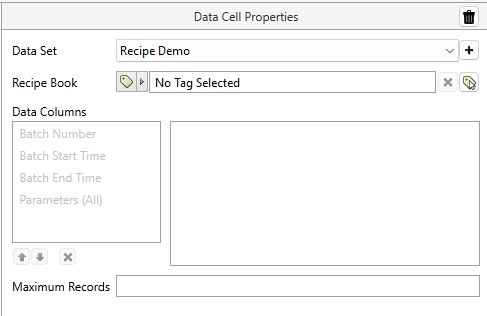
Selecting the table cell will open Data Cell properties to the right. Change the Data Set to a Recipe Batches type.
The Data Cell will inherit the parent Data Set configurations by default.
Click Available Data Fields to select each one and see how they are configured. You cannot change them while "Use data set defaults" is enabled.
Disabling "Use data set defaults"
To make variations for this cell, uncheck "Use data set defaults". Disabling data set defaults will enable all of the Available Data Fields configuration options for this cell only.
Select Data Fields to see their configuration options. Change headers, format, and summary suppression. Add, remove or rearrange the data columns.
These changes will only affect the selected Data Cell and will not alter the parent Data Set.
