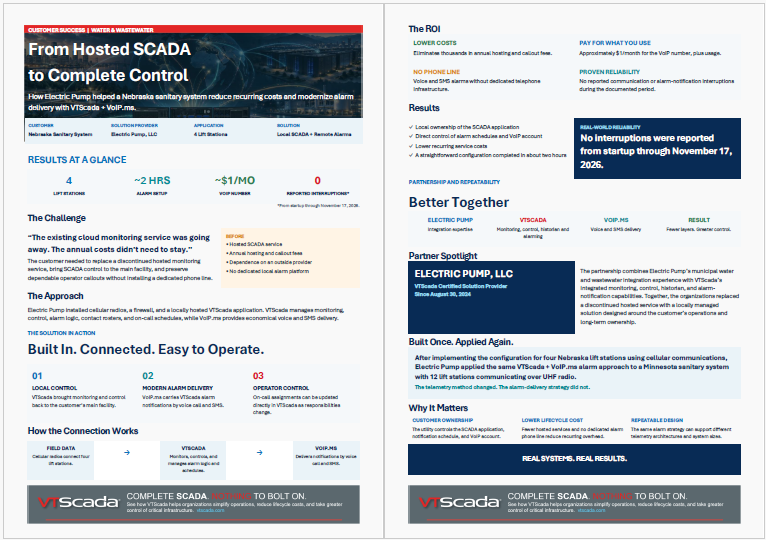
How Electric Pump Modernized Lift Station Alarm Management with VTScada and VoIP.ms
At a Glance
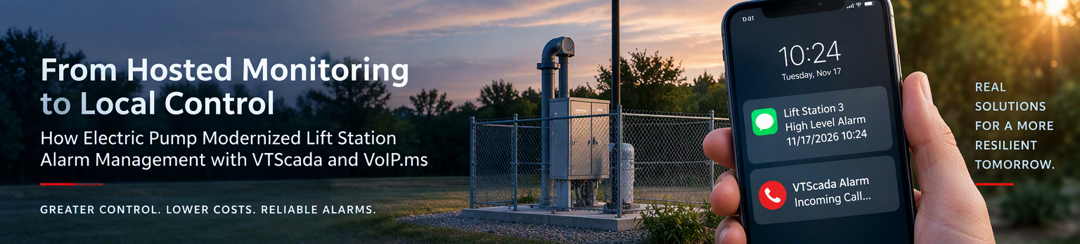
- 4 lift stations connected in the Nebraska deployment
- Approximately 2 hours to set up the VoIP.ms account and configure VTScada alarm notifications
- No reported interruptions from startup through November 17, 2026
- Thousands of dollars in former annual hosting and callout fees eliminated
- Approximately $1/month for the VoIP.ms number, plus usage
- 12 additional lift stations using the same alarm-notification approach in a separate Minnesota application
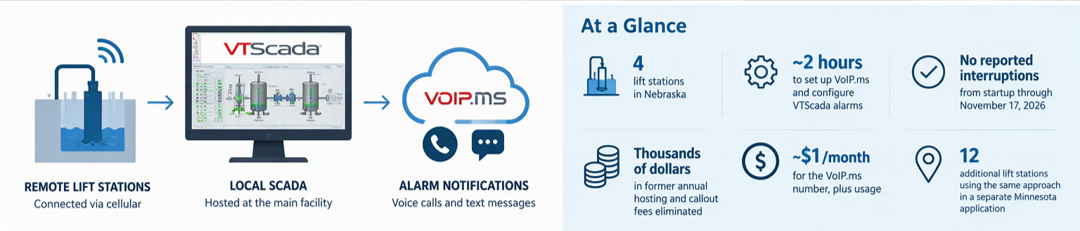
When a cloud monitoring provider announced it would discontinue its service, a Nebraska sanitary system faced an immediate challenge: how could it continue monitoring and controlling four remote lift stations while ensuring that critical alarms still reached the operator on call?
The existing service worked, but it came with a significant recurring cost. The customer had been paying thousands of dollars each year for hosted SCADA monitoring and alarm callouts. With that service being discontinued, the situation created an opportunity to rethink the architecture rather than simply replace one hosted service with another.
The customer wanted to bring SCADA monitoring and control back to its main facility, gain greater ownership of the system, and continue receiving dependable alarm notifications. Just as importantly, the customer wanted to accomplish this without adding and maintaining a dedicated phone line solely for alarm callouts.
The result was a solution developed by Electric Pump that combined locally hosted VTScada, cellular communications, and VoIP.ms voice and SMS services.
Bringing SCADA Back In-House
In July 2026, Electric Pump installed cellular radios to connect the four lift stations with the customer’s main facility. A firewall was added, and Electric Pump developed a locally hosted VTScada application to provide the monitoring and control previously supplied through the cloud service.
Moving the SCADA application on-site gave the customer greater ownership of a critical part of its operations. Instead of depending on an external monitoring provider to host the system, the organization could manage its SCADA environment locally while continuing to communicate with the remote lift stations over the cellular network.
But monitoring and control addressed only part of the challenge. Operators still needed to know immediately when something required attention, particularly when no one was sitting in front of the SCADA workstation.
Modern Alarm Delivery Without a Dedicated Phone Line
For remote alarm notification, Electric Pump integrated VTScada with VoIP.ms.
The roles of the two systems are complementary. VTScada monitors the process, identifies alarm conditions, and manages the alarm roster and callout schedule. VoIP.ms provides the telecommunications service used to deliver those notifications to operators through voice calls and text messages.
The approach allowed the customer to maintain the familiar benefits of phone-based alarm notification without maintaining a traditional dedicated telephone line.
Better still, the implementation was straightforward. Setting up the VoIP.ms account and configuring VTScada for alarm notifications took approximately two hours.
Once implemented, operators gained greater control over the day-to-day notification process. When on-call responsibilities change, they can update the callout schedule directly in VTScada. The customer also retains direct access to its VoIP.ms account, providing additional visibility and ownership of the communications service.
A Partnership Focused on Practical SCADA Solutions

The project also demonstrates the value of the relationship between VTScada and Electric Pump. Electric Pump became a VTScada Certified Solution Provider in 2024, combining its hands-on experience in municipal water and wastewater systems, controls, telemetry, and field integration with the integrated monitoring, control, historian, and alarming capabilities of VTScada.
Rather than approaching the Nebraska project as simply a software replacement, Electric Pump was able to design a complete solution around the customer’s actual operational requirements. Cellular telemetry connected the remote assets, VTScada provided the local monitoring and control environment, and VoIP.ms provided an economical path for getting important alarm information to operators.
This is also an example of what the VTScada Certified Solution Provider relationship is designed to enable: experienced system integrators applying VTScada to real-world operational challenges while having access to the product, training, technical support, and other resources needed to build and support applications. The CSP program is specifically intended to support integrators with tools, support, training opportunities, referrals, marketing resources, and commercial incentives as they deploy VTScada for their customers.
For the end user, the advantage is straightforward. Instead of assembling a collection of disconnected services, the customer gets a solution built around its operations by an integrator that knows both the field environment and the SCADA platform.
Reliability from Day One
Cost savings are important, but for wastewater operations, reliability remains essential.
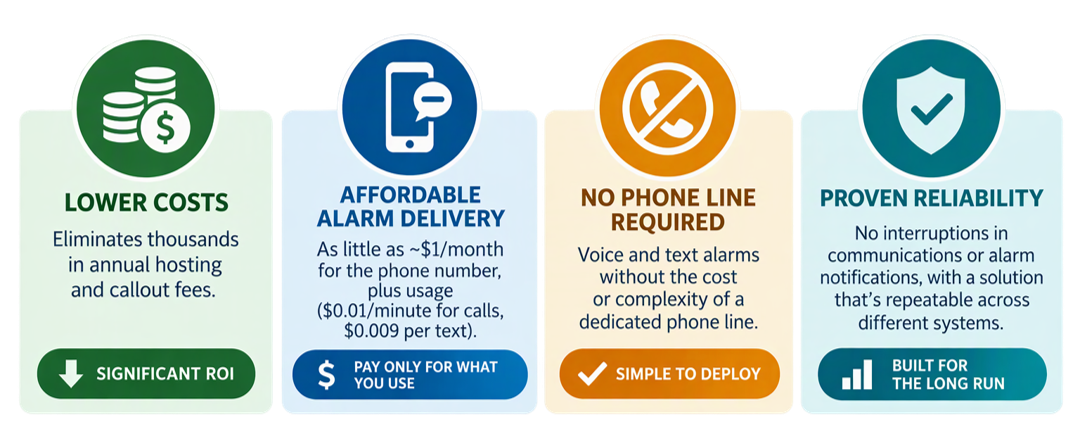
From startup in July through November 17, 2026, Electric Pump reported no interruptions in lift station communications or alarm notifications.
That means the solution accomplished more than replacing the discontinued service. It provided the customer with a locally controlled SCADA system while maintaining dependable communications between the remote stations, the central application, and the operators responsible for responding to alarms.
Replacing Recurring Costs with a More Economical Model
The business case is equally compelling.
By hosting VTScada at the main facility, the customer eliminated the former provider’s annual hosting and callout fees, which had been costing thousands of dollars annually.
The customer’s ongoing expenses now consist primarily of annual VTScada license support, cellular service, and usage-based VoIP.ms charges.
For this installation, the VoIP.ms number costs approximately $1 per month. Voice calls cost approximately $0.01 per minute, while text messages cost approximately $0.009 each.
That usage-based model is particularly well suited to SCADA alarm notification. Instead of paying for an entire dedicated communications service regardless of how often it is used, the customer pays a relatively small base cost and then incurs additional charges when notifications are actually sent.
The benefit goes beyond the telecommunications bill. Eliminating the hosted monitoring and callout service reduces recurring costs while giving the customer more direct control over its SCADA application and alarm workflow.
One Alarm Strategy, Different Communications Networks
Perhaps one of the most interesting aspects of the project is that the approach was not limited to a single customer or telemetry architecture.
Electric Pump subsequently implemented the same VTScada and VoIP.ms alarm configuration for a Minnesota sanitary system operating 12 lift stations.
Unlike the Nebraska application, where the four lift stations communicate using cellular radios, the Minnesota stations communicate over UHF radio.
The technology used to get field data back to SCADA was different, but the alarm-delivery strategy did not need to be.
Once the station information reached VTScada, the same basic VoIP.ms configuration could deliver voice and text notifications to the appropriate operators. This separation between the field communications network and the alarm-notification method demonstrates an important benefit of the architecture: organizations can choose telemetry technology suited to their geography and existing infrastructure without having to reinvent the operator notification process.
More Control, Fewer Dependencies
For the Nebraska sanitary system, the need to replace a discontinued cloud service ultimately became an opportunity to build something more sustainable.
The four lift stations are now connected to a locally hosted VTScada application. Operators receive alarm notifications by voice and text. On-call schedules can be maintained directly inside the SCADA environment. The customer has direct access to its communications account. And recurring hosting and alarm-callout fees have been replaced by a much leaner combination of software support, cellular connectivity, and usage-based communications costs.
Just as importantly, the approach has already demonstrated that it can be adapted to a larger 12-station system using a completely different radio technology.
What started as a requirement to replace a discontinued service therefore became something bigger: a more flexible, customer-controlled approach to lift station monitoring and alarm management that reduces recurring costs without compromising reliability.
For Electric Pump and VTScada, it is also a strong example of what an effective integrator partnership can deliver. The SCADA platform provides the foundation, the Certified Solution Provider brings the application and field expertise, and technologies such as VoIP.ms can be incorporated where they deliver practical value.
Fewer ongoing dependencies. Greater operational control. Lower recurring costs. And a solution that can be repeated as the customer’s needs evolve.
More on VoIP.ms and VTScada

Download the PDF Case Study